A PLACE IN THE CITY'S HISTORY
M. V. Frunze Memorial House Museum
Then
Pishpek
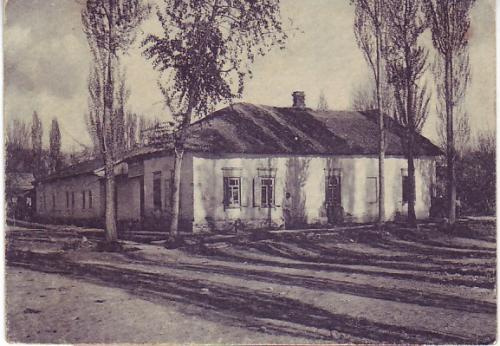
Source and rightsАвтор фотографии: И.Н.Панова
Now
Bishkek

Source and rightsАвтор фотографии: Ринат Ибрагимов
A PLACE IN THE CITY'S HISTORY
M. V. Frunze Memorial House Museum
Pishpek
on the south-eastern corner of Sudeiskaya and Vasilyevskaya streets. Soon after the transfer of the district administration from the city of Tokmak to Pishkek, military paramedic Vasily Mikhailovich Frunze submitted a petition to the head of the Tokmak district for permission to occupy a place in Pishpek to build a house on the corner of Vasilievskaya and Sudeiskaya streets. Four windows of the house, decorated with platbands with wooden shutters, faced Vasilyevskaya Street, and on the Sudeyskaya side there were two windows and a main entrance to a vast veranda open to the courtyard. Adjacent to the house was a long outbuilding with storage rooms, a summer kitchen and an outpatient clinic. Vasily Frunze kept a pharmacy in his house. And although he served as a paramedic, he sometimes performed the duties of a doctor, and his work in this field was very useful. Residents of not only the city of Pishpek, but also the surrounding villages, were constantly drawn to Frunze’s house, and the street to his house began to be named after the paramedic himself - Vasilievskaya. His son Mikhail Frunze, a major Bolshevik military and political figure, spent his childhood years in this house. In 1896, he was sent to study at the gymnasium in the city of Verny, the only one in the Semirechensk region at that time. Frunze's mother, Mavra Efimovna, sold the house to the doctor Fyodor Vladimirovich Poyarkov, and she herself bought a house on Klyuchevaya, where she lived until the death of her son Mikhail in 1925. In 1926, a local history museum was opened in the Frunze house. In 1937, they began the “restoration” of the house-museum and rebuilt it beyond recognition. The reed roof was replaced with tin, and an exhibition hall was added. The house was lengthened, the window openings were enlarged, and the shutters were removed. In the parental home of Mikhail Frunze, the Museum of the Revolution was set up, and in the outbuilding there was a house-museum of M.V. Frunze. In 1967, Vasily Frunze’s house was destroyed during the construction of a new museum complex.
Frunze
Photo from 1978. Memorial Museum of M.V. Frunze. The new pavilion, which opened on October 29, 1967, was built in the form of a rectangle resting on columns, the space between which is filled with glass and granite; on the facade walls there is a thematic bas-relief depicting scenes from the revolutionary and military activities of M.V. Frunze. The authors of the memorial are architects Y. Karikh and G. Kutateladze and artists A. Voronin and A. Kamensky. Frunze Mikhail Vasilievich (1885-1925). Participant of the October Revolution of 1917. Prominent Soviet party and military figure. According to archival information, in 1890, retired paramedic Vasily Frunze owned real estate: a house of 4 rooms and an outbuilding with three rooms, wooden floors and ceilings, a reed roof, a barn, a stable, a carriage house, and a garden. The Central Museum of Kyrgyzstan was located in the house of Vasily Frunze in 1926. Since 1937 – Museum of the Revolution named after M.V. Frunze. Photo from 1932. After reconstruction since 1940 - the Memorial House-Museum of M.V. Frunze. Photo from 1963. In 1967, a new museum building was opened. During its construction, Frunze's parental house was destroyed. Inside the original building there is a courtyard building - an outbuilding, presented as a house where M.V. was born and spent his childhood. Frunze. Sudeiskaya Street in 1927 was renamed Frunze Street.
Bishkek
The M. V. Frunze Memorial House Museum continues to operate in Bishkek at 364 M. Frunze Street. According to the museum’s official history, it was founded in 1925 and received its first visitors in 1927. The present museum building opened in 1967; it preserves the surviving courtyard wing associated with the Frunze family. In 2002 the museum complex was entered in the State List of Historical and Cultural Monuments of the Kyrgyz Republic as a monument of national significance. Thus, the Bishkek-era material records not a vanished institution but the present stage of a museum that developed from the Pishpek family estate and the Soviet memorial museum.
What changed
No information found yet
Source and rights