A PLACE IN THE CITY'S HISTORY
Agricultural school building
Then
Pishpek
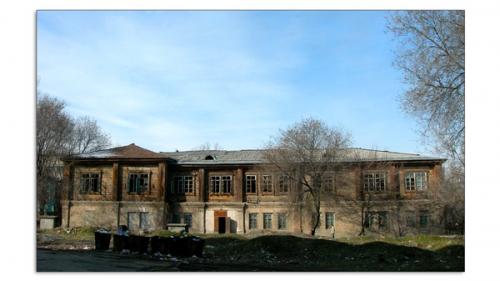
Source and rightsАвтор фотографии: Виктор Глумсков
Now
Bishkek

Source and rightsАвтор фотографии: Пятый Пятый
A PLACE IN THE CITY'S HISTORY
Agricultural school building
Pishpek
Demolished in 2005 In 1889 A.M. Fetisov founded the Kyrgyz school of gardening. Its students were fully supported by funds raised by the Kyrgyz population. The main goal was for students to master gardening and vegetable gardening skills. The course of study at the school lasted three years. After Fetisov's death in 1894, the school was headed by Ilya Pavlovich Ivanov. Under him, the school and its garden were in exemplary order. The school was located in a private house. On the territory of the State Garden, ornamental plants, fruit and berry, fruit and vegetable gardens were grown, greenhouses and flower beds with all kinds of flowers were maintained. The garden was located on the site of the Panfilov Park, and where the greenhouses were, the White House now stands. There was a breeding farm, rams of the “Spanish-Schwyz breed”, 200 heads of Semipalatinsk cows, a stable on Uezdnaya Street (later transferred to the fire department, which was on Old Square, just opposite the house with columns). After the harsh winter of 1914-15, the fruit trees in the city froze and the school was completely moved outside the city. The school’s suburban grounds, the “zaimka”, were located where the buildings of the Scriabin Agricultural Academy are now located. The new buildings were built by a specialist - foreman Gorynin from Verny. Timber for wooden houses was brought from Issyk-Ata and Kemin. Subsequently, an agricultural technical school was created on the basis of the horticulture school, and then the Agricultural Academy.
Frunze
Information not foundA translation for the selected language is not ready yet.
No information found yet
Bishkek
A translation for the selected language is not ready yet.
No information found yet
What changed
No information found yet
Source and rights